

The Constitutional Question Everyone Is Avoiding
Debate over 2020 election has focused on the wrong questions.


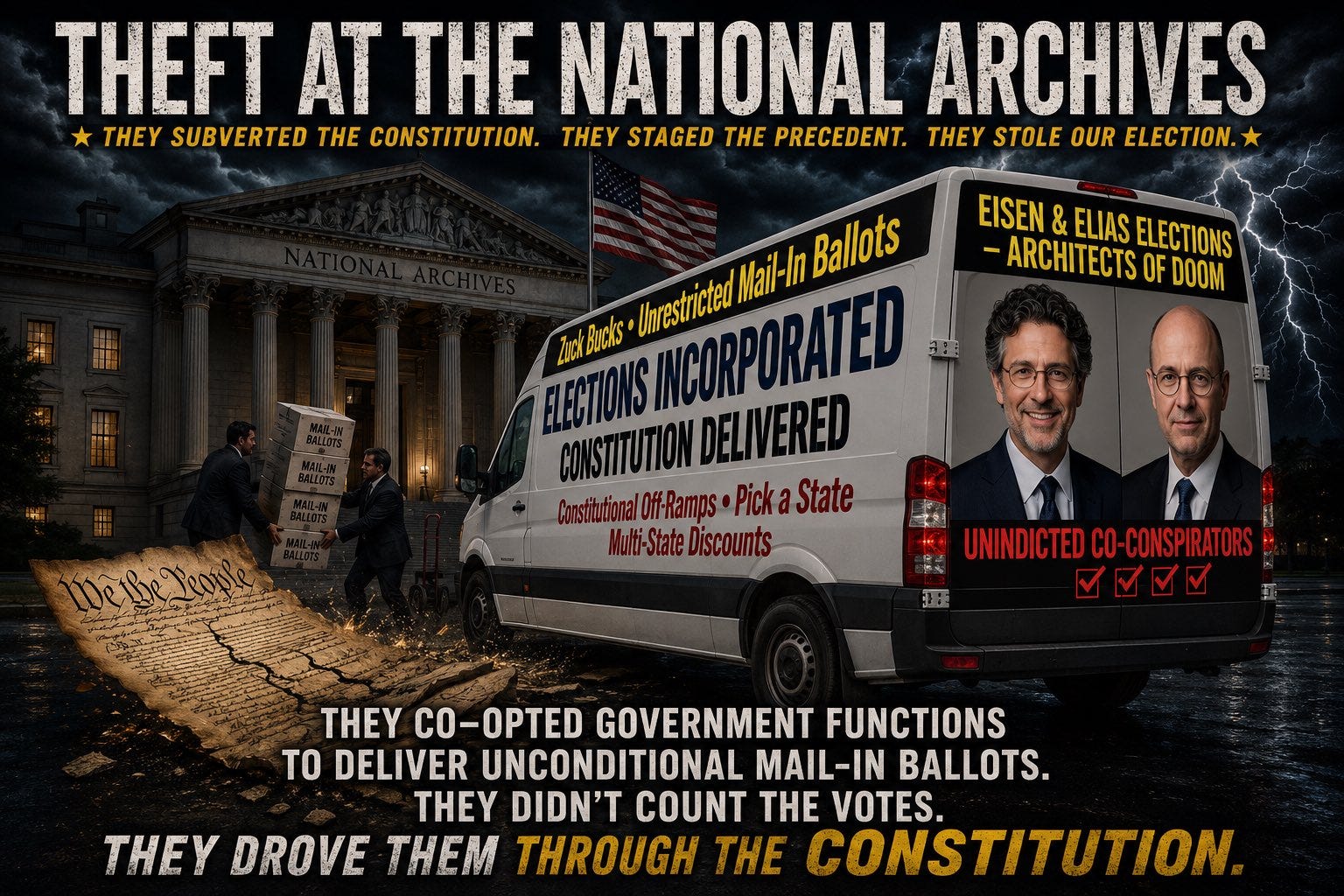
Originally published on X by Chris Filby
Flashback to 2020
On May 26, 2020*, during a White House press briefing, President Donald Trump warned that a dramatic expansion of mail-in voting presented serious risks to election integrity. He argued that large-scale mail voting could lead to fraud, confusion, and disputes over election results, predicting that the November election could become one of the most contested in American history.
*Timestamp 1:23:45:
Whether one agreed with those warnings or dismissed them at the time is ultimately not the constitutional question. The debate over the 2020 election has focused almost entirely on the wrong questions.
It is not about voting machines.
It is not about counterfeit ballots.
It is not about ballot harvesting, signature verification, or whether enough votes were fraudulent to change the outcome.
It is not even about whether Donald Trump or Joe Biden should have been President.
Those questions all come after the one that matters most:
Was the Constitution Followed?
Article I, Section 4 of the United States Constitution assigns responsibility for prescribing the "Times, Places and Manner" of federal elections to the state legislatures, subject to Congress's authority to alter those regulations. The Framers deliberately vested that responsibility in a specific branch of government because the allocation of power matters as much as the power itself.
During the COVID-19 pandemic, election procedures were altered across many states through executive directives, administrative actions, consent decrees, and judicial orders. Whether those actions were prudent or necessary is not the constitutional issue.
The constitutional question is whether officials other than the state legislatures exercised authority that Article I assigns to the legislatures.
Emergencies do not rewrite the Constitution.
They do not erase its separation of powers.
Emergency powers are constitutional only when exercised pursuant to lawful authority granted by the Constitution or by legislation enacted under it.
When emergency actions transfer constitutional authority from the branch to which it was assigned, the constitutional problem is not the emergency itself.
The constitutional problem is the transfer of power.
Courts also play an essential role in safeguarding constitutional government. Yet election disputes frequently place judges in politically charged circumstances. That reality makes it especially important that courts not assume powers the Constitution assigns to another branch of government.
Why This Matters
Constitutional powers do not belong to one political party.
Any interpretation of emergency authority accepted today may be invoked tomorrow by officials pursuing entirely different objectives.
Imagine a future administration declaring election security, public health, cyber threats, or another emergency as justification for changing election procedures without legislative action. Whether one favors those policies is beside the point.
Constitutional authority cannot depend upon whether we approve of the policy or the person exercising it.
The Constitution is either binding when it is inconvenient, or it is not binding at all.
Every expansion of emergency power establishes a precedent that future officeholders may invoke. Constitutional limits exist precisely because emergencies tempt governments to exceed them.
This debate is not about relitigating one election.
It is not about Donald Trump or Joe Biden.
It is about preserving a constitutional system in which no emergency, no President, no Governor, no Secretary of State, and no court may assume powers that the Constitution assigns elsewhere.
History will continue to debate the outcome of the 2020 election.
The Constitution asks a different question:
Who had the lawful authority to change the rules under which that election was conducted?
Until that question is answered, the constitutional debate has never really begun.
Related
Remarks: Donald Trump Discusses Protecting Seniors With Diabetes - May 26, 2020:
President Trump Addresses the Nation on 11.05.20:
America Mission Stream July 16, 2026:
America Mission™: MAYM™
📢 Part of our mission is keeping We The People informed on what the heck Congress is doing. We have no paywalls for our work.
Find Out How You Can Support America Mission
Whether is picking up some official AM merch, subscribing to AM X, or a one-time donation you can help our all-volunteer team continue to help Make America YOUR Mission™.

 | A guest post by
|